
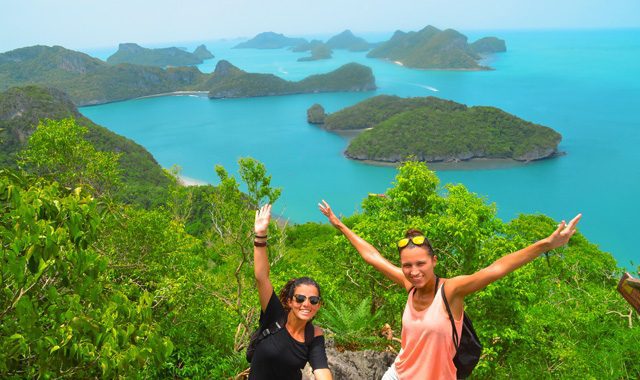
Thailand 101
You’ve been dreaming of traveling to the beautiful Kingdom of Thailand. As you get ready to depart you quickly realise that you don’t know much about the Land of Smiles. Even if it’s not your first time in Thailand, let us guide you and give you a rundown of what to expect and prepare you for your adventure.
Language
The official and main language spoken in Thailand is Thai. English is the most common second language as many Thais have studied some level of English at school.
Whenever possible use the Wai (saluting with your hands together and bowing slightly), Thai people appreciate when foreigners show interest in their customs and use basic Thai greetings or sentences.
Currency
The local currency is the Baht (B) which comes in denominations of ฿20 (green), ฿50 (blue), ฿100 (red), ฿500 (purple) and ฿1,000 (beige). Keep in mind that the larger the note, the larger the denomination. ATMs accepts all major credit cards and some may also accept foreign debit cards. Most ATMs will allow you to withdraw ฿10 000 and some up to ฿20 000.
Almost anywhere in Thailand you can negotiate the price of an item or service. Know that tuk-tuks will try to overcharge you at first. Negotiate and settle the price for your ride right before hopping in.
Sim Cards
While Wi-Fi is available at most restaurants, bars and hotels, getting a sim card and staying connected is relatively easy and affordable in Thailand. There are 3 major suppliers in Thailand: True, DTAC and AIS. All three networks will give you 4G signal in almost every popular tourist destination. You can buy a sim card at most cell phone stores, 7-eleven, Family Mart, Big C and of course at official mobile internet provider shops. Like in most countries, you can buy a sim card and data plan at the airport however the prices tend to be much higher than what is available elsewhere. To purchase a sim card, you will need to present a passport or a piece of identification. Some street vendors may sell prepaid data packages without any identification, but the official resellers will need ID and may ask to take a picture. There are several plans available of various durations, which all can be topped-up.
Adapter
Depending on your country of origin, you may not need an adapter. Thailand electrical outlets accept the 2 and 3 flat prong outlet commonly used in America and as well as the 2 round prong outlet used throughout Europe.
Tipping
The Thai service industry generally does not expect tips but it’s common to leave your small change at the restaurant or rounding up a taxi fare.
Water
Drinking water from the tap is not recommended; drink boiled or bottled water instead. Ice is generally produced from purified water. Use your common sense when travelling in the country. The same thing goes for food; a packed and clean looking place will most likely be safe.
Driving
In Thailand, they drive on the left side of the road. You must carry an international driving permit to drive. Carry your home country driver’s licence, your international driving permit and vehicle registration book at all times. Having a valid licence is critical, not just to avoid being fined by police for breaking the law, but especially in case you are involved in an accident.
Health
Dengue and Zika infections are a risk in Thailand. Protect yourself from mosquito bites. This includes covering up and using insect repellent. If you show any symptoms or feel ill, visit the local hospital. Thailand’s health care system is considered one of the best in the world. Don’t be afraid to use it, if necessary.
Religion
The official religion in Thailand is Buddhism and is practiced by more than 95% of the population. There are a great number of stunningly beautiful and intricate temples across the country. If you want to see how Thai people practice Buddhism in their daily lives, take a look at a nearby Spirits house. A Spirit house is which a tiny, little building in which spirits live. Phi in Thai means ghost or spirit. You will see them everywhere in Thailand. Every building, store or house has its own house. A phi house looks like a colourful toy house decorated with flowers and bowls of fruit and glasses filled with red liquid.
Temples
There are approximately 30,000 Buddhist temples in Thailand. In addition to being a place of worship and celebration, these temples often house monks, schools and are places of gathering for locals. Many temples will have a market just outside of their doors. If you plan on visiting the inside of these stunning architectural wonders be prepared to cover your shoulders and knees (all genders) and your ankles as well.
Alcohol & Drugs
In Thailand, alcohol is legal and widely available. The local population is also happy to drink alcohol and sometimes even more than tourists.
As for drugs, it is important to know that marijuana and narcotics are considered illegal drugs in Thailand and possession or distribution of it is a criminal offence. The Thai authorities are very strict with illegal substances. The possession of even small amounts of illegal drugs, including marijuana, can result in severe fines and prison sentences.
Thailand 101 Fun Facts
- Thai people have four meals a day.
- Locals don’t eat with chopsticks or use a knife. They eat with a spoon in the right hand and a fork in the left.
- The world’s biggest Chinatown is located in Bangkok.
- Thai people consider the head as the most sacred part of the body and the feet the least. Never touch anyone on the head and never point at anything with your feet. Both acts are considered disrespectful.
- Thailand uses a different calendar. The official year in Thailand is 2562 (not 2019). January 1 is now a public holiday in Thailand however the New Year’s days for Thai people takes place from April 13 to 15 and is called Songkran.
- In Thailand, the royal family is adored and deeply respected by its citizens. The Hollywood movie “The King and I” was banned from Thai cinemas upon its released as it was deemed to be derogatory towards the King. Thailand has the world’s longest reigning monarch in the world. King Bhumibol Adulyade reigned over Thailand for over 70 years. The King owned a patent on a type of cloud seeding, had an engineering degree from Switzerland and composed the national anthem.
- Every November, there is a festival dedicated entirely to monkeys. During the festivals, Thai people invite over 600 monkeys to feast on a buffet of rice, tropical fruits, salad, grilled sausages and even ice-cream. This festival is meant to bring good luck as well as saying thank you to the monkeys who bring thousands of tourists to the city each year.
- Thailand is home to a fish that can technically walk on land. The Cryptotora Thamicola, also known as the blind waterfall-climbing cavefish, uses its two front and two back fins to climb up waterfalls.
- Thailand is the birthplace of Red Bull. The sweet non-carbonated energy drink has been around since 1976 but the version that we know and drink today was born in 1987 to better suit the taste of Westerners.
Do you have interesting facts to to add to our Thailand 101? Is there anything you would like to pass on to future tourists visiting the Land of Smiles? Please share them with us using the comment box below.
Thailand 101 was written by: Stéphanie Dashnay @sdashnay


